Unisound Selected for the Hang Seng TECH Index as Revenue Growth Accelerates and Growth Potential Translates into Results
On November 20, Hang Seng Indexes Company announced the results of its quarterly review of the Hang Seng TECH Index, with Unisound (09678.HK) selected for inclusion. The changes will take effect on December 7, 2026.
Announcement excerpts (English translation)
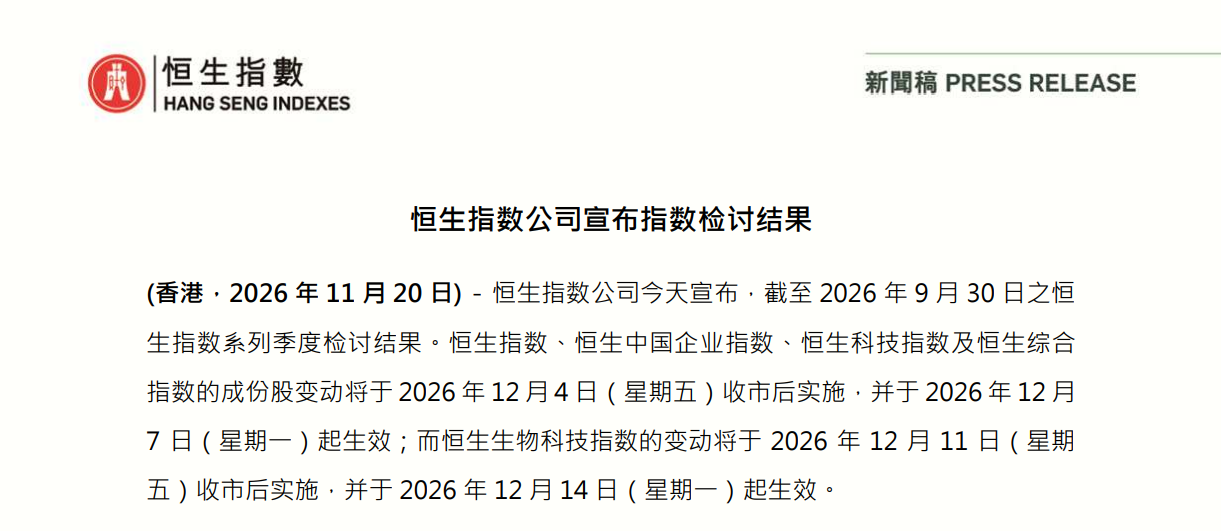
Hang Seng Indexes Company Announces Index Review Results
(Hong Kong, November 20, 2026) – Hang Seng Indexes Company today announced the results of the quarterly review of the Hang Seng Family of Indexes for the period ended September 30, 2026. Constituent changes to the Hang Seng Index, Hang Seng China Enterprises Index, Hang Seng TECH Index and Hang Seng Composite Index will be implemented after the market closes on Friday, December 4, 2026, and will take effect on Monday, December 7, 2026. Changes to the Hang Seng Biotech Index will be implemented after the market closes on Friday, December 11, 2026, and will take effect on Monday, December 14, 2026.
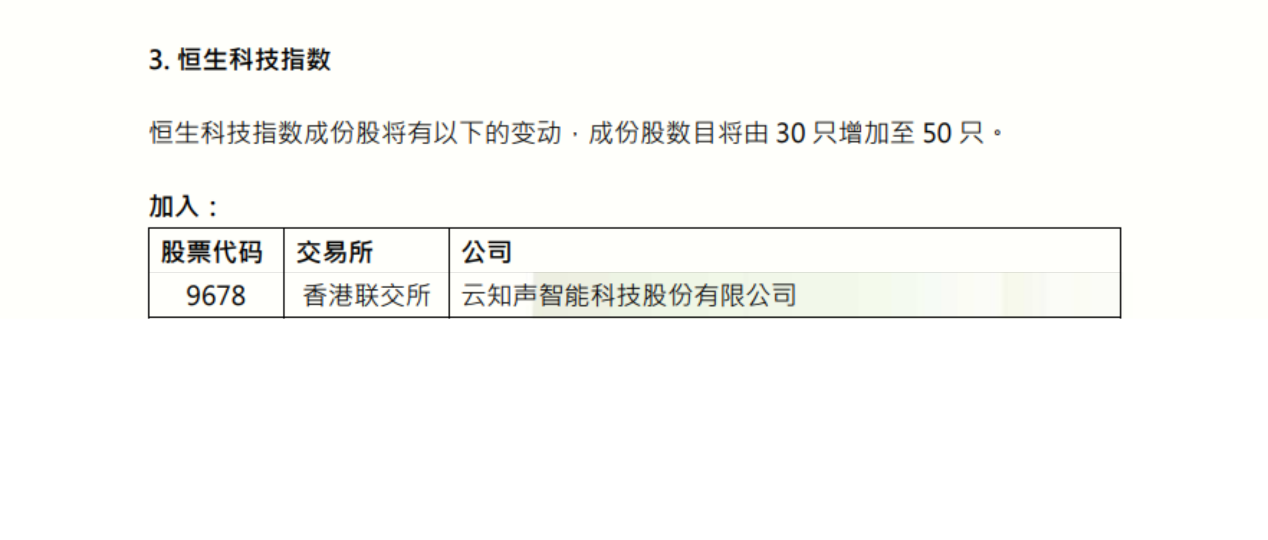
3. Hang Seng TECH Index
The following changes will be made to the constituents of the Hang Seng TECH Index. The number of constituents will increase from 30 to 50.
Addition:
The Hang Seng TECH Index is a flagship technology index representative of the Hong Kong market and an important benchmark for international investors seeking exposure to Chinese technology assets. According to Hang Seng Indexes Company, global passive assets tracking the index totaled approximately US$37.1 billion as of the end of September 2026. Inclusion will further raise Unisound’s visibility in international capital markets and signals that its business growth has attracted the attention of a leading international index provider.
Hang Seng TECH Index Inclusion Reflects Growth, Scale and Liquidity
This review introduced a “Revenue Growth” selection group for the Hang Seng TECH Index for the first time. Companies in this group are selected based on their ranking by the latest disclosed revenue growth over the preceding 12 months. Eligible companies must have recorded annual revenue of at least HK$500 million in each of the two most recent consecutive financial years. New constituents must also meet requirements including average daily turnover of at least HK$100 million over the preceding three months.
Unisound’s inclusion reflects its sustained business growth in recent years:
In the first half of 2026, Unisound recorded revenue of RMB562 million, up 38.7% year on year, and gross profit of RMB186 million, up 42.0%. Revenue from its large language model (LLM) API (Token) business approached RMB30 million, with second-quarter revenue growing by more than 500% from the previous quarter. The business achieved a gross margin of over 60%, while repeat purchases accounted for more than 60% of its revenue. The LLM business has become an important growth engine for the company, reflecting its accelerating progress in translating years of technological development into tangible business results.
More Than a Decade of Technological Development Supports Sustained Business Growth
Selection for the Hang Seng TECH Index provides a comprehensive assessment of Unisound’s growth and further demonstrates its ability to deliver commercial results under its strategy of strengthening foundation models and deepening industry applications.
Founded in 2012, Unisound has consistently focused on the research, development and commercialization of core AI technologies. From its early work in speech technology to industry AI and now foundation models, the company has progressively built a technology stack spanning AI chips, AI computing platforms, general-purpose foundation models and industry AI agents.
With its U-Model series of agent-native foundation models at the core, Unisound has built a business operations platform on a model portfolio that combines general-purpose, specialized and multimodal capabilities. The platform comprises three layers: foundational capabilities, intelligent application development and value-generating operations. It brings AI into enterprises’ core business processes, helping increase revenue, reduce costs and improve efficiency across key areas including healthcare, transportation, finance, industry and office work.
Healthcare is the sector in which Unisound has the longest track record. As of the first half of 2026, the company had served more than 470 medical institutions, over 80% of which were Grade III Class A hospitals. These capabilities are also being extended to medical insurance and commercial insurance. In 2026, two teams that Unisound helped form each won a first prize in the national medical insurance AI image recognition competition, further demonstrating the company’s technological expertise and practical capabilities in healthcare AI.
From the Hang Seng Composite Index to the Hang Seng TECH Index, Expanding Its Capital Market Presence
Following its listing in June 2025, Unisound was included in the Hang Seng Composite Index on September 8 that year. On the same day, the Shanghai and Shenzhen stock exchanges added the company to their lists of eligible securities for southbound Stock Connect trading, making its shares accessible to mainland Chinese investors. Unisound has progressed from a broad-based index covering the Hong Kong market to a flagship technology index in less than a year and a half.
The move from the Hang Seng Composite Index Series to the Hang Seng TECH Index further expands Unisound’s index coverage in the Hong Kong equity market. Its inclusion in the Hang Seng TECH Index marks a milestone in the company’s long-term investment in technology and business development.
The AI industry is moving from competition in model capabilities toward deeper integration between technology and industry. As foundation model capabilities continue to improve, the ability to convert technological advantages into sustainable commercial growth is becoming an important measure of the quality of an AI company’s development. Unisound will continue to pursue innovation in core technologies, deepen the integration of foundation models with industry applications, and enable AI to create greater value across industries.